Think about the last big purchase you made. Maybe you had new windows installed in your house or hired a tree removal specialist. Did you purchase from the first business you Googled—without doing any research or contacting them?
Probably not. In every purchasing decision we make, we go on a journey. And we all use the same map. Here at Hughes Integrated, we call it the Audience Journey. Sometimes the journey is short, like the purchase of a latte or a new pair of jeans. Other times, it’s longer, like the purchase of a new car—or even college tuition. The bigger the purchase, the longer the journey.
The audience journey is a key way to build trust with a prospective client, thus forging a strong relationship. And as a service-based business, you’ll want their business again. The audience journey is the map that can lead your audience right to your doorstep. The secret is meeting your ideal clients where they’re at, not where you want them to be. This involves knowing where they’re at on their journey and what they need at each juncture.
Overview of the Audience Journey

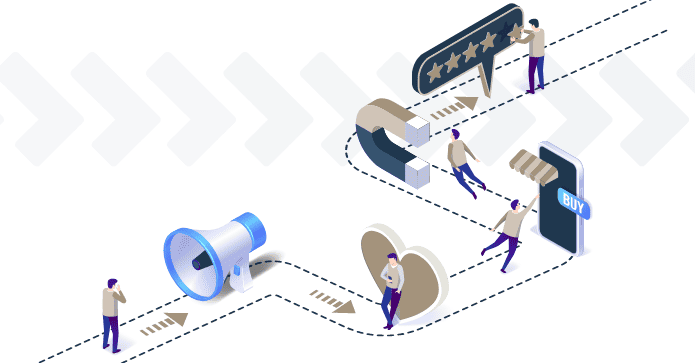
The audience journey goes by many names—you may have heard it called the buyer’s journey, the client journey, or simply the customer journey. Regardless, it always follows the same pattern:
- Awareness. Your audience becomes aware of your business and what you do.
- Consideration. Your audience researches you and your competitors to determine who will best serve them.
- Commitment. Your audience becomes your client. They sign the contract and make the purchase.
- Loyalty loop. After they become a client, your audience becomes advocates for your brand. They tell their friends about you and buy from you again.
Note that the audience journey is not a straight line. It’s a series of circles and loops because it’s an ongoing process. We’ll break this down further as we go. To follow this map, let’s follow the footsteps of some travelers as an example:
Stanley and Martha are in their mid-50s, both employed and have three children who are college-age and above. One day, Stanley’s employer brings up his future at the company he works for, mentioning Stanley’s eventual retirement. Stanley mentions this to Martha, and now they realize they might need a financial planner. They now realize that they have a problem. Let the journey begin.
Awareness
Awareness is when your audience is first introduced to your brand. Maybe it’s through a Google search, maybe it’s through word of mouth. This is when your ideal audience learns your name and discovers what you offer. If they have a problem you can solve, they might search your business name on Google later on to learn more about you.
Now that Stanley and Martha have realized they need a financial planner, they Google “financial advisors near me” and research a few. They may even ask their friends what financial advisor they use. This is how they become aware of Fuller Financial. They look at the office’s website and Google Business Profile. While scrolling Facebook to find their daughter’s wedding photos, they may see the occasional ad for Fuller Financial and other financial offices.
Put Awareness Into Practice
In the above story, we snuck in a few ways you can put awareness into practice in the audience journey. Let’s break those down:
- Rank for relevant keyphrases on Google so you are easier to find. Fuller Financial’s website ranks for “financial advisors near me,” so Stanley and Martha were able to find them easily.
- Set up a Google Business Profile. This is like your listing in a Yellow Pages book but on the internet. Fuller Financial has a Google Business Profile complete with their location, photos of their office, a list of their services, and reviews left by Google users.
- Run awareness ads. Fuller Financial set up social media awareness ads that targeted Stanley and Martha’s demographic. These ads don’t call the audience to any action other than to visit their website—Stanley and Martha aren’t ready to sign a contract with anyone yet. It is too early in their journey to make a decision. First, they have to do some research.

Consideration
Now that your audience is aware of who you are as a company, they will start to consider you and your competitors to solve their problem. Consideration is a time of growing familiarity. Prospects learn new things about your brand and puzzle over what it means for them. Keep in mind that consideration takes time, especially if the investment is significant. Note in the graphic above that consideration is a loop of its own. Your audience may take one loop around, or they may take 100.
Stanley and Martha are now scheduling a few phone calls and appointments with local financial planners, including Frank Fuller of Fuller Financial. On Fuller’s website, Stanley and Martha book a consultation with Frank, leaving their email and phone number. After their consultation, Frank sends them an automated series of emails that addresses the problem they face and answers common questions about retirement planning. He also sends them a blog called “The Ultimate Retirement Planning Guide for Soon-to-Be Retirees.” Stanley and Martha find other valuable information about saving for retirement on his website.
Put Consideration Into Practice
Frank offered a free, no-obligation consultation to Stanley and Martha to get to know them and their needs. This is a call to action—but instead of immediately asking for the sale, Frank offered a low-stakes opportunity to get to know him and his advising style. Another tactic he could’ve used was a free download of a retirement workbook.
Frank also captured Stanley and Martha’s email when they signed up for a consultation. As a result, the couple was put into an email nurture sequence that addressed their problem, eliminated objections, and offered helpful advice that demonstrated Fuller Financial’s authority.
Other tactics Frank could have used include:
- Highlighting positive reviews on his website as social proof.
- Offered a free service, like a complimentary second opinion on their financial plan.
- Actively post on Fuller Financial’s Facebook page about market trends, helping his clients and prospective clients make sense of the stock market.

Commitment
Commitment is when your audience member makes a decision—to buy from you. They’ve considered their options and they are ready to do business with you! Your potential client is now a client.
While you’ve earned their trust, going from prospect to client is a big leap. They are committing time and money to partner with you.
After a few weeks of considering Frank and other financial advisors, Stanley and Martha feel that Frank is the most qualified and knowledgeable advisor they’ve met. They sign a contract with Frank and begin the next phase of their client relationship with him.
Put Commitment Into Practice
The best thing you can do in the commitment phase is make it as simple as possible to buy from you. This means having a clear call to action. Consider these call-to-action best practices:
- Your call to action should be prominent on your website. Place a call-to-action button at the top of your page, throughout your website copy, and in your emails to prospective clients.
- Use consistent language. If you want your prospect to buy now, tell them to “buy now.” If you want them to download an e-book, tell them to “download the e-book.” Be consistent in every call-to-action.
- Be clear and direct. “Learn more” and “click here” don’t tell your prospect what they are learning or clicking. Be as direct as possible. Use “about us” instead of “learn more” or “get the guide” instead of “click here.”
Loyalty Loop
While your client has made their purchasing decision, your relationship with them is far from over. You’ve earned their trust, and they want to partner with you. Now it’s time to earn their loyalty. This loop is where you continue to serve your client, offering value and building an even deeper connection. This leads to repeat business, glowing referrals, and satisfied customers.
Stanley and Martha are now Frank’s clients, but Frank continues to nurture his relationship with them. They meet quarterly to discuss the couple’s portfolio, but throughout the year, Frank will send them market insights. Stanley wants to start withdrawing from Social Security at 65, so Frank offers some resources on how to save on taxes and make the most of these funds. He also gives them exclusive access to a new money management software he has been trying out with long-term clients.
Put the Loyalty Loop Into Practice
In the loyalty loop, you no longer have to convince your client to be your client. You now have the freedom to nurture the relationship you’ve built with them and add value to it. Like Frank, you can provide exclusive offers, like discounts on services or free trials. The loyalty loop is also a time for loyalty or referral programs. Frank might offer Stanley and Martha a percentage off a year’s service if they refer a friend to Fuller Financial.

The Secret to Quality Marketing is Forming Relationships
Now that we’ve mapped out the audience journey—from awareness to loyalty—you can see why it’s important to meet your potential clients where they’re at.
And good marketing accounts for every stage of the audience journey.
It doesn’t pretend that decisions are isolated, but connects with your audience wherever they’re at. It speaks to their specific needs and questions, walking with them as they go from first impression to raving fan.
Prospects don’t often know they are on a journey when purchasing. But now you do. Using simple strategies at each stage of the journey, you can become the guide they want you to be, and they can become the client you’ve always wanted.
Are you curious about other ways to build a relationship with potential clients? Attend our free webinar, “Marketing is Relationship,” on Wednesday, December 21 at noon EST! Sign up today—even if you can’t attend live, we will send you a recording afterward!