

Creating a clear brand message is the first and most important step in any successful marketing strategy. Businesses large and small need to work on their brand messaging before they publish a website, post on social media, send a sales email, or buy an ad.
In this article, we’ll provide an all-encompassing rundown of brand messaging, including an explanation of what a brand message is, why a clear brand message is important, and a step-by-step guide to creating a message that attracts and converts your ideal audience. Plus, we illustrate each part of the process with a behind-the-scenes look at how Hughes Integrated, a brand messaging agency, crafted our own brand voice and brand identity.
A brand message is the story a business communicates through all of its marketing. It is the central ideas, themes, and value propositions that represent a brand across digital platforms, customer interactions, and sales.
In general, a brand message breaks down into two main parts: brand identity and brand voice.
Brand identity is a company’s answer to who are you? It is the distinct characteristics that define a brand, help it stand out from competitors, and make it memorable to consumers.
Brands can have personalities just like a person—they can be funny, serious, elegant, approachable, exciting, peaceful, or a combination of a million other traits. These characteristics can be unique and very creative, but they must remain clear and consistent. A brand with an identity crisis will quickly confuse consumers and lose their attention.
Think of major brands like Apple, Nike, and Starbucks.
Across commercials, websites, social media, and even in-store displays, you’ll see they’re portraying a consistent brand identity.
Apple says, “I’m creative, elegant, and exciting.”
Nike says, “I’m athletic, bold, and stylish.”
Starbucks says, “I’m fun, comforting, and confident.”
These strong brand identities mean that wherever you encounter one of these companies, you know exactly who you’re dealing with.
If brand identity is who a brand is, brand voice is how it communicates. What tone and personality does it use in its language? How does it sound when it is talking to you?
Brand voice determines how consumers receive a brand’s message, just like the tone of a narrator shapes how we experience a story. Voice is also how we recognize a brand, just like a certain word choice or style of speech can tell you who is talking long before you see a face. A brand voice will communicate a company’s values and personality long before a consumer has consciously processed their identity.
Voice must be consistent with a brand’s mission and values. It should reflect the target audience’s preferences and communication style.
While many people will want to dive straight into building their brand message, there are two important things to consider first:
A brand messaging agency is a team of professionals that can guide you through the branding and messaging process.
Many business leaders are simply too close to their work to have a clear view of the story that they’re telling. Brand messaging agencies provide expertise and fresh objectivity to help you get the strongest end result with the least amount of headaches. They’re also an ideal partner when it comes time to implement your brand messaging strategy throughout your marketing.
In order to get the most out of your strategic messaging, we recommend using a brand messaging framework.
A brand messaging framework is simply a templated process that you can use to brainstorm and organize your thoughts. It will help you keep your message focused and consistent without wasting time on unnecessary details.
Our preferred brand messaging framework is the StoryBrand framework. Created by best-selling author Donald Miller (and popularized in his book Building a StoryBrand), the StoryBrand messaging framework uses the seven elements of great storytelling to organize a brand’s message in a way that gets consumers to listen and invites them to take action. At Hughes Integrated, we’ve seen this framework transform the ways companies communicate and audiences respond.
Now that you have an understanding of what a brand message is and why it’s important, it’s time to learn how to create a clear brand message. In this section, we’ll walk you step-by-step through the process of building a brand identity and creating an authentic brand voice, using a behind-the-scenes look at the Hughes Integrated rebrand as an example to illustrate each part of the journey.
While some may advocate starting with your company—your values, your history, etc.—we believe that it’s actually more effective to start with your target audience.
A target audience is a specific group of people or demographic that a business aims to reach and engage with through its marketing efforts. It is a group of individuals who share common characteristics, such as age, gender, income, education, interests, behaviors, or geographic location, that make them more likely to be interested in a particular product, service, or brand.
Your target audience has specific needs, preferences, and behaviors. You need to understand these because the story you’re telling depends on who you’re telling it to. If your brand message is strongly tailored to your target audience, it will be more likely to resonate and lead to conversions.
So, how do you find your target audience?
You may already have a sense of your target audience, but we recommend starting with some market research.
Market research is the process of gathering demographic and psychographic information about your core audience. It uses a few strategies and tools to figure out exactly who wants to buy from you and why. There are also opportunities to figure out what is working for your competitors and what’s not.
As you may guess, market research can be an extensive process. Depending on your industry, you can gather reams of data over periods of months or years. While this information is certainly helpful, we find it’s best to start with a simpler approach.
If you have an existing customer base, start by learning more about them. What do your customers have in common? What problems were they facing before they did business with you? Why did they choose your company over others? How did working with you make them feel? How are their lives better now?
You don’t want to just guess how your customer feels. The more you can get these answers in their words, the better. Send out surveys and write down everything you’ve heard them say. Compile reviews and testimonials. Then save all of this information.
Once you’ve gathered some information about your target customer, we recommend organizing it into a buyer persona.
Ideal buyer personas represent the type of person you want to attract and do business with. It will describe their demographics, wants, emotions, and pain points. That way you can get clear on who you’re talking to before you begin crafting your brand story.
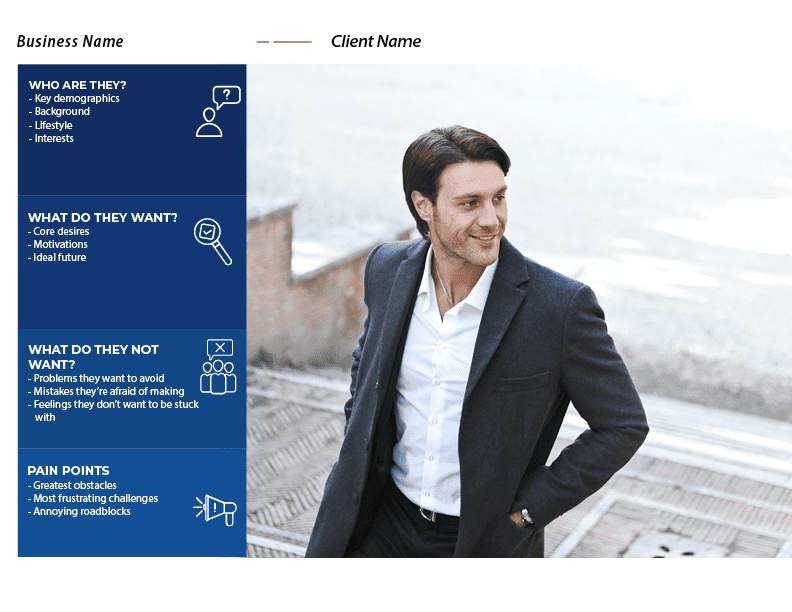
When Hughes Integrated began our own rebrand, we started by identifying our target audience.
Since our team has been helping businesses across the country for years, we started by looking at existing and past clients. We knew each client well but tried to take a step back and evaluate them objectively. We noted their industry, business size, location, and more and then compared this to their experience working with us. How good of a fit were we? What value did they see in our work? And in their own words (via surveys we sent out) why did they enjoy working with us? We then compiled all of this information into a spreadsheet.
Here are a few things we found:
After a little more market research, our team organized this information in a buyer persona.
The next part of building a brand message is understanding how you help your target audience. Your value is why existing customers do business with you and why prospective customers need to buy from you.
This is more about discovering your value than making it up. You can find this information in some of the market research you compiled. Review customer testimonials and look for the things they said about your brand. Why did they like working with you? What characteristics are noted again and again? Are there any patterns? If so, you may have uncovered your unique value proposition.
To check your idea, look at your competition—not to copy them, but to notice where you’re different. You might find yourself saying, “My competitor really emphasizes x, but here we’re all about y.” What is it about your process, offerings, or identity that make you stand out from them?
Our team looked at the information from our target audience (see above) and started highlighting patterns.
We noticed a few things right away:
When we reviewed these takeaways, our unique value was staring us in the face: relationship. We help brands develop relationships with their ideal audience. And we do it through ongoing partnerships and meaningful relationships with our clients. Other agencies also create marketing campaigns but our team really excels at developing relationships.
Once you know who you’re talking to (target audience) and what you offer (unique value proposition), you’re ready to establish your brand identity. Consider: who is the best “person” to present your offering to your audience? What characteristics do they possess? What kind of first impression do they give? How do they act? What do they say?
In the case of Hughes Integrated, since we offer relational marketing, the best “person” to offer this is very personable themselves. They’re inviting, warm, helpful, empathetic, and authentic. They are approachable but you know they have their stuff together. You can tell they’re there to support you and they use their speech to build you up and empower you to be successful. They’re the kind of person you want to be around for a long time.
This “person” is a casual description of our brand identity. It reflects who we are as a company (it’s no coincidence that it describes our team) and describes how we want to present ourselves.
Go through the same exercise and you’ll describe your own brand identity.
After you know who your brand is, you have to decide how they speak. This tone, personality, grammar, etc. is your brand voice.
Your brand voice should have two key features:
With these features in mind, you’ll be able to come up with a list of guidelines for your brand voice.
You can tell who Hughes Integrated is because of how we speak. Our voice is engaging and joyful because we are. We’re approachable so we don’t use overly complicated marketing jargon. And we want to be helpful so we focus on clear writing rather than textbook grammar rules (though believe us, our copywriters can write circles around Grammarly).
Again, we want to be open-handed with this, so here’s a snapshot of how we describe our voice internally:

Before you’ve rolled out your brand messaging to the masses, it’s a good idea to test your identity and voice. This will help ensure you’re on the right track and can guide you through some of the more minute decisions (does my audience prefer this word or that word?).
First, start by testing your brand messaging internally. Does your team get it? Does it feel like it fits or is it completely out of left field? (Note that this should be a big-picture pass/fail, not a red pen to every word. Your audience will be the best judge of the details.)
Speaking of your audience, next send out small tests to your best customers and prospects. Try out different wordings or phrases and see what people respond to. Show your value proposition to a trusted few and ask them what they think. We’ve found email is an easy way to see what resonates (you can control who sees the test and you get same-day results). Use these tests to make adjustments and refine your brand messaging as needed.
Once your brand messaging is clearly on the right track, it’s time to align the design. We strongly recommend working through this after you have a clearly written brand identity and voice. Otherwise, you can quickly burn through resources debating colors and fonts when you’re not quite sure who your brand is.
While design comes after the words, it’s still very important. Your logo, fonts, colors, style, etc. are a key part of the message you’re communicating. They need to show the same ideas that you’ve articulated through copy. There’s a lot of professional work that goes into this (you can go down a rabbit hole of color psychology and font families), but the key is to make sure design is consistent with your message. It should convey the same values and personality as your words.
To display Hughes Integrated’s brand identity we developed a fresh logo and brand guidelines. We chose visual elements that proudly declare our brand identity to the world. Our design is clean and approachable. It’s not overly complicated or trendy but hints at the relationship values at the core of our brand. (See if you can find the hidden meaning in our logo!)

If you’ve worked through all of the content in this article, you have a clear idea of what brand messaging is and why it’s important. You should also have practical steps you can take to create a message that resonates with your audience and grows your business.
But our team recognizes that this is a lot of information. Brand messaging is very important but it’s also a monumental challenge. That’s the reason we’re taking the time to walk you through each part of launching a brand in this series.
Even more, it’s why we’re proud to do what we do. We delight in helping people like you craft a brand message that your audience will love. So if brand messaging is something you want to really take seriously, reach out to our team. We would be glad to see if our process is right for you.